

For a high earner, the right comparison between municipal and corporate bonds is the after-tax yield, not the stated rate. Municipal interest is generally exempt from federal income tax, so a lower coupon can leave you with more money than a higher taxable one. The higher your marginal rate, the more that exemption is worth. Credit quality, call features and liquidity decide whether the math holds up in practice. At Shore Tax & Financial Planning, we run this comparison against your actual return, because the tax side is where most of the answer sits.
In both cases you lend money to an issuer. In return you receive scheduled interest and your principal back at maturity, as Investor.gov explains. The differences are who borrows and how the interest is taxed.
| Feature | Municipal bonds | Corporate bonds |
|---|---|---|
| Issuer | States, cities, counties and related public entities | Private or public corporations |
| Federal tax on interest | Generally exempt | Taxable at ordinary rates |
| State and local tax | May be exempt if you live in the issuing state | Generally taxable |
| Typical stated yield | Lower | Higher |
| Main repayment source | Taxing power or project revenue | Company cash flow |
| Liquidity | Often thin | Generally more actively traded |
The tax rows come from Investor.gov’s municipal bond guidance. It notes that comparable tax-exempt bonds normally carry lower stated rates than taxable securities such as corporates. State Street’s U.S. guide adds that corporate interest is generally taxed at ordinary federal and state rates.
Municipal bonds are not one product. Investor.gov separates general obligation bonds, backed by an issuer’s general fund or taxing power, from revenue bonds, which depend on the income of a specific project such as a toll road or water system. Some conduit bonds are issued for private borrowers like nonprofit colleges or hospitals. Two muni bonds can carry very different risk, so the label alone tells you little.
The lower coupon is the price of the tax break. The Congressional Research Service explains the mechanism: exempt interest lets state and local governments borrow at lower rates, because investors accept a smaller coupon when the after-tax return matches a taxable bond. The exemption works mainly as a financing subsidy for the issuer, and you share in it.
Federal Reserve researchers studied how municipal yields are set. After controlling for default and liquidity risk, the tax rates implied by muni yields were close to the statutory rates for high-income individuals and corporations. In other words, the market prices munis for investors in the top brackets. That is why the comparison tends to favor munis for you and not for someone in a low bracket.
To compare fairly, convert the muni yield into what a taxable bond would have to pay to leave you with the same amount after tax:
Tax-equivalent yield = municipal yield ÷ (1 − your marginal tax rate)
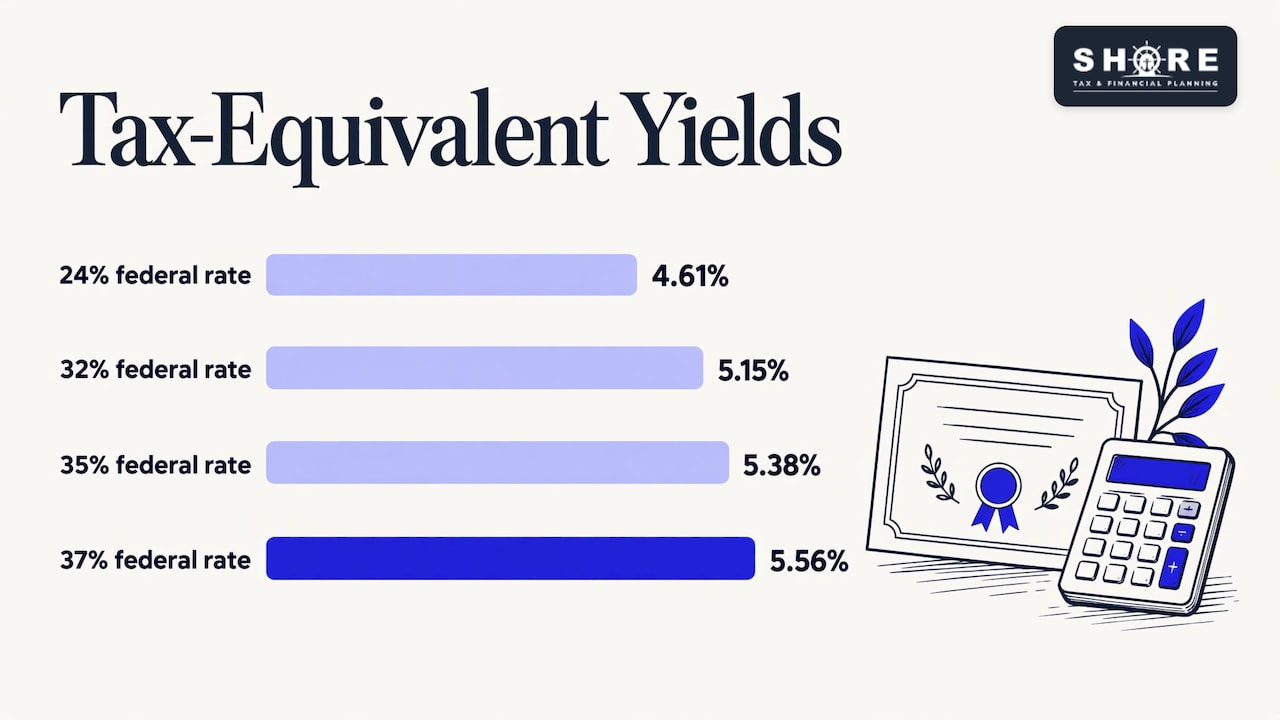
Investopedia’s guide shows a 4% municipal yield equating to about 4.5% at a 12% rate and about 6% at a 35% rate. Here is an illustration with a 3.5% muni yield (the number is hypothetical, not a market quote):
| Your federal rate | Tax-equivalent yield on a 3.5% muni |
|---|---|
| 24% | 4.61% |
| 32% | 5.15% |
| 35% | 5.38% |
| 37% | 5.56% |
If a comparable corporate bond yields less than the figure in your row, the muni wins on federal tax alone. If it yields more, the corporate wins, before you adjust for risk.
Yields move daily with interest rates and credit spreads. Pull the current quote for the exact bond you are considering rather than relying on any rate printed in an article.
Your marginal rate is rarely just the bracket. Three additions change the result:
A tax-exempt bond can also change other parts of your return, so run it against the full picture and not the bond alone.
The federal exemption survived the 2025 tax law. The Government Finance Officers Association reported that the One Big Beautiful Bill Act, signed July 4, 2025, preserved the exemption for tax-exempt municipal bonds, qualified private-activity bonds and 501©(3) bonds. The Congressional Research Service confirms that federal law excludes interest on public-purpose municipal bonds from federal income tax, with qualified private-activity bonds also excluded under statutory conditions.
Tax law can change again, and your own bracket can too. That is a reason to review the comparison each year and not buy once and forget.
Tax savings mean little if the bond does not perform. Three risks deserve your attention.
Corporate bonds generally carry more issuer-default risk, and lower-rated ones pay higher yields because of it, according to State Street. Municipal bonds still carry credit, interest-rate, call, inflation and liquidity risk. Investor.gov notes that a municipal credit rating estimates relative risk and does not mean a bond cannot default. For revenue bonds, read what revenue backs the bond and how much cushion it has.
Many municipal bonds are callable. The issuer can repay them early, usually when rates fall, and you are left to reinvest at lower yields. The same Investor.gov bulletin tells investors to examine call provisions. Compare the yield to the call date as well as the yield to maturity.
The Federal Reserve study found municipal bonds are much less liquid than Treasuries, equities, futures and foreign exchange. Liquidity sensitivity rises with maturity and falls with credit quality. It estimated that liquidity premiums made up 7% to 20% of observed municipal yields, depending on rating and maturity. For a 20-year bond the estimate was 65 basis points for AAA, 79 for AA/A and 111 for BBB. That study dates from 2005, so treat the figures as a sense of scale, not today’s spreads.

In practice, a thinly traded bond can cost you more to sell than you expect. Plan to hold individual munis to maturity or to a call date. For a closer look at how trading depth affects exit costs in any market, see this explainer on market cap versus liquidity.
Municipal bonds tend to fit when:
Corporate bonds tend to fit when:
The second point is where most investors go wrong. Putting a tax-exempt bond in a tax-deferred account throws away the benefit you paid for through a lower yield. Which account holds which asset is a planning question of its own, and we cover it in our guide to asset location strategy. If you hold bonds through funds, our comparison of ETFs and mutual funds covers how those structures are taxed.
Say you are a profitable S-corp owner in the 35% bracket, with income high enough to owe NIIT. You have $200,000 to invest in a taxable account and are looking at two bonds of similar maturity and credit quality. One is a municipal bond yielding 3.5%. The other is a corporate bond yielding 5.0%. All numbers are hypothetical.
The muni leaves you about $880 more per year before state tax. At a 24% bracket with no NIIT, the corporate bond would keep about $7,600 and win. Same bonds, different answer, because of your tax profile. The credit and call risk of each specific bond still has to be checked on top.
Bond selection is half the decision. The other half is your income, entity structure, state and account types, which determine your real marginal rate. Our lead advisor holds both CPA and CFP credentials, and we are fee-only: we earn no commissions and sell no products. That means the comparison you get is built around your return, not a product.
We offer year-round tax advisory and investment management for high W-2 earners and year-round advisory for business owners. If you want the bond decision tested against your full tax picture, our tax reduction planning is where that work starts.

If you are weighing whether tax planning or tax preparation is the better fit for you, see tax prep vs. tax planning.
Most investors ask which bond yields more. The better question is which one leaves you with more after every tax you actually pay. That depends on your bracket, your state, NIIT, and the account the bond sits in.
We see the bond decision as one move inside a year-round tax plan. As a fee-only firm with no commissions and no products to sell, our advice has one aim: reducing what you owe, legally and defensibly. Our lead advisor has both CPA and CFP credentials and has run a business, so we look at the whole return, not just the portfolio.
A muni can be the right call in one year and the wrong one the next, as income, entity structure and state of residence change. That is why we revisit it with you throughout the year and not once at filing time.
Joseph
Often, on an after-tax basis. Municipal interest is generally exempt from federal income tax, so at higher brackets a lower muni yield can beat a higher corporate yield. The answer still depends on the specific bonds’ credit quality, call features and your state taxes.
Yes, in some cases. Investor.gov says investors should check whether a bond is subject to the federal alternative minimum tax. State tax exemption usually applies only when you live in the issuing state. Bonds bought at a discount or sold at a gain can also create taxable gains.
Taxable bonds, including corporates and Treasuries, pay interest that is subject to federal income tax, though Treasury interest is exempt from state and local tax. Muni bonds pay interest that is generally federally exempt. To compare them, convert the muni yield to a tax-equivalent yield using your marginal rate.
Usually not. Retirement accounts already defer or shelter tax on interest, so a muni’s exemption adds nothing there while you accept its lower yield. Municipal bonds typically belong in taxable accounts, and taxable bonds in tax-deferred ones.