

An asset location strategy decides which account holds each investment: taxable, tax-deferred (such as a traditional IRA or 401(k)) or tax-free (such as a Roth). The goal is to put tax-inefficient holdings, like taxable bonds, in accounts that shelter income, and tax-efficient holdings, like broad stock index funds, where taxes are already low. Your overall mix of stocks and bonds stays the same. Only the address of each holding changes, and with it the tax bill you pay every year.
This guide explains how the three account types are taxed, which investments usually fit where, how much the strategy can realistically add, and where it goes wrong. It is written for high earners and business owners who hold money in several account types at once.
Asset allocation is the split of your portfolio among asset classes, for example 70% stocks and 30% bonds. It sets your risk level. Asset location is the placement of those holdings across your taxable, tax-deferred and tax-free accounts. It sets how much of the return you keep after tax.
The two work in sequence. The Bogleheads wiki on tax-efficient fund placement puts it plainly: set your allocation first, then let taxes decide where each fund sits. Never change your risk level just to chase a tax result.
Here is the part many investors miss. Your allocation applies to the household, not to each account. Smartleaf explains that separate accounts can jointly match one target allocation even when one is mostly equities and another mostly fixed income. Your 401(k) can be 100% bonds and your brokerage account 100% stocks, and the household can still be 60/40.
| Asset allocation | Asset location | |
|---|---|---|
| Question answered | How much in stocks, bonds, cash, real estate? | Which account holds each investment? |
| Main driver | Goals, time horizon, risk tolerance | Tax treatment of each account and each holding |
| Effect | Risk and expected pre-tax return | After-tax return |
| Changes when | Your goals or risk tolerance change | Tax law, your bracket or your account balances change |
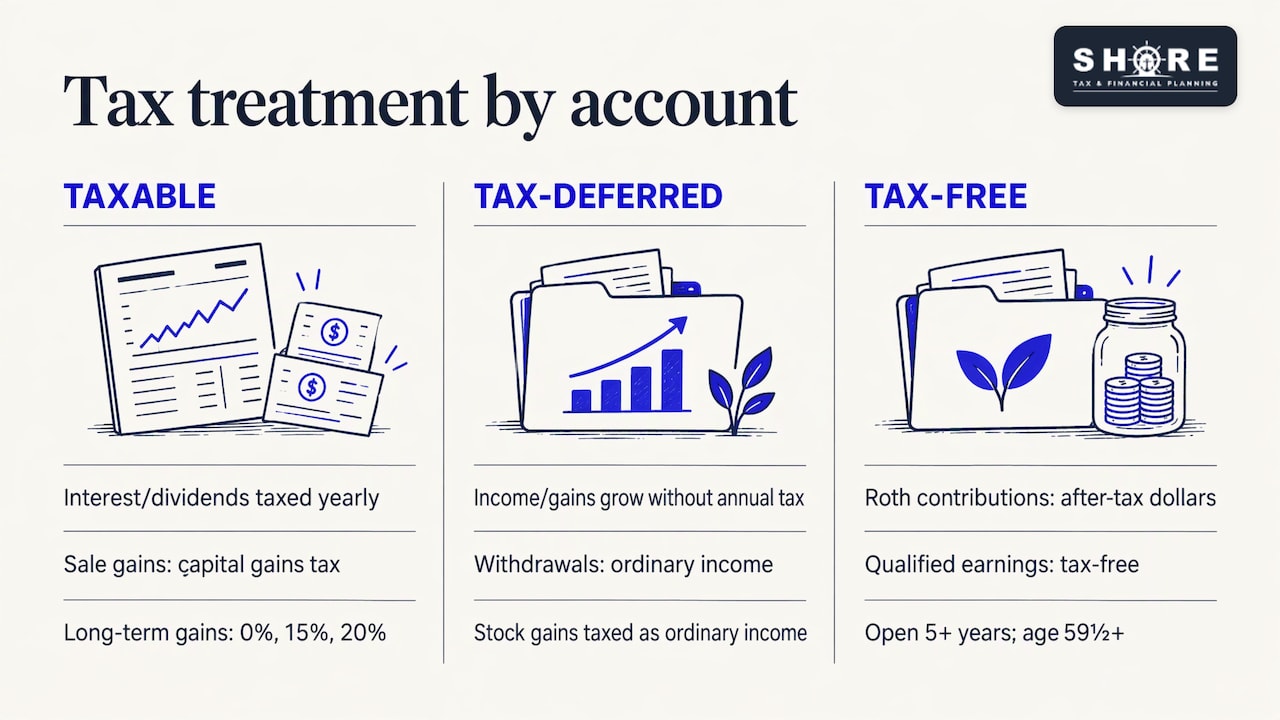
The whole strategy rests on three different tax treatments.
Taxable accounts. You pay tax on interest and dividends each year. When you sell at a gain, you owe capital gains tax. Investopedia notes that long-term capital gains are taxed at 0%, 15% or 20%, which is typically lower than ordinary income rates.
Tax-deferred accounts. Traditional IRAs and 401(k)s let investments grow without annual tax on income or gains. Withdrawals are taxed as ordinary income, whatever the original source of the growth. That last point matters: a stock gain held in a traditional IRA is eventually taxed at ordinary rates, not capital gains rates.
Tax-free accounts. With a Roth IRA, you contribute after-tax dollars. FINRA states that qualified withdrawals of earnings are tax-free if the account has been open at least five years and you are at least 59½ when you withdraw.
So the tax cost of each holding depends on where it lives. Interest from a taxable bond fund is taxed at your ordinary rate each year in a brokerage account, but not at all in a traditional IRA until you withdraw.
The common rule matches each asset’s tax profile to the account’s tax profile.
Investopedia describes the standard guidance: taxable bonds, REITs and related funds belong in tax-deferred accounts, because their interest and dividends would otherwise be taxed at higher ordinary income rates. Actively managed funds that trade often and distribute short-term gains are also candidates, since the account absorbs that churn.
Broad stock index funds and ETFs generate little taxable income, and their gains are taxed at long-term rates when you sell. They also let you hold for years and choose when to realize gains. If you want to understand why ETFs tend to distribute fewer gains than mutual funds, our piece on ETFs vs. mutual funds walks through it. Taxable accounts also give you tax-loss harvesting, which tax-deferred accounts do not.
Municipal bonds are a special case. Their interest is generally exempt from federal income tax, so holding them in a tax-deferred account wastes that feature. For investors in high brackets who want bonds in a taxable account, they are a natural fit.
Because qualified Roth withdrawals are tax-free, the account rewards assets you expect to grow the most. Many planners place the highest-growth equities here. The conventional approach, bonds in the traditional account and growth stocks in the Roth, is a sensible default, not a law. Janus Henderson’s Ben Rizzuto notes that expected return is the most important factor in effective asset location, with tax inefficiency layered on after that.
| Investment | Typical home | Why |
|---|---|---|
| Taxable bond funds, TIPS | Traditional IRA or 401(k) | Interest is taxed as ordinary income |
| REITs | Traditional IRA or 401(k) | Most dividends are taxed at ordinary rates |
| Actively traded funds | Tax-deferred account | Frequent distributions are sheltered |
| Broad stock index funds and ETFs | Taxable account | Low turnover, long-term gain rates |
| Municipal bonds | Taxable account | Interest is generally federally tax-exempt |
| Highest-growth equities | Roth account | Growth is never taxed if rules are met |
Say you have $500,000 across three accounts and want 60% stocks and 40% bonds, which is $300,000 in stocks and $200,000 in bonds. These figures are illustrative, not a forecast.
Without location planning, each account holds the same 60/40 mix. The $80,000 of bonds in the brokerage account throws off interest that is taxed every year at your ordinary rate.
With location planning, you put the full $200,000 of bonds into the 401(k). The brokerage account holds $200,000 of stock index funds, and the Roth holds $100,000 of stocks. The household is still $300,000 stocks and $200,000 bonds. Nothing about your risk changed. The annual bond interest is now sheltered, and your taxable account produces mostly long-term-rate gains and qualified dividends.
That is the entire idea. The same portfolio, arranged differently, loses less to tax each year.
The honest answer is: a modest amount per year that compounds, and it depends on your situation.
Two things move the number. The first is your bond allocation: the more fixed income you hold, the more interest there is to shelter, so the benefit grows. A portfolio that is almost entirely equity has little bond interest to move. The second is your tax bracket. A higher bracket widens the gap between the ordinary income rate on interest and the lower rate on long-term gains, which is why this matters for high-income professionals and profitable business owners.
On a $2 million portfolio, 20 basis points is $4,000 a year, and 60 basis points is $12,000. Those savings repeat and compound without taking any extra market risk.
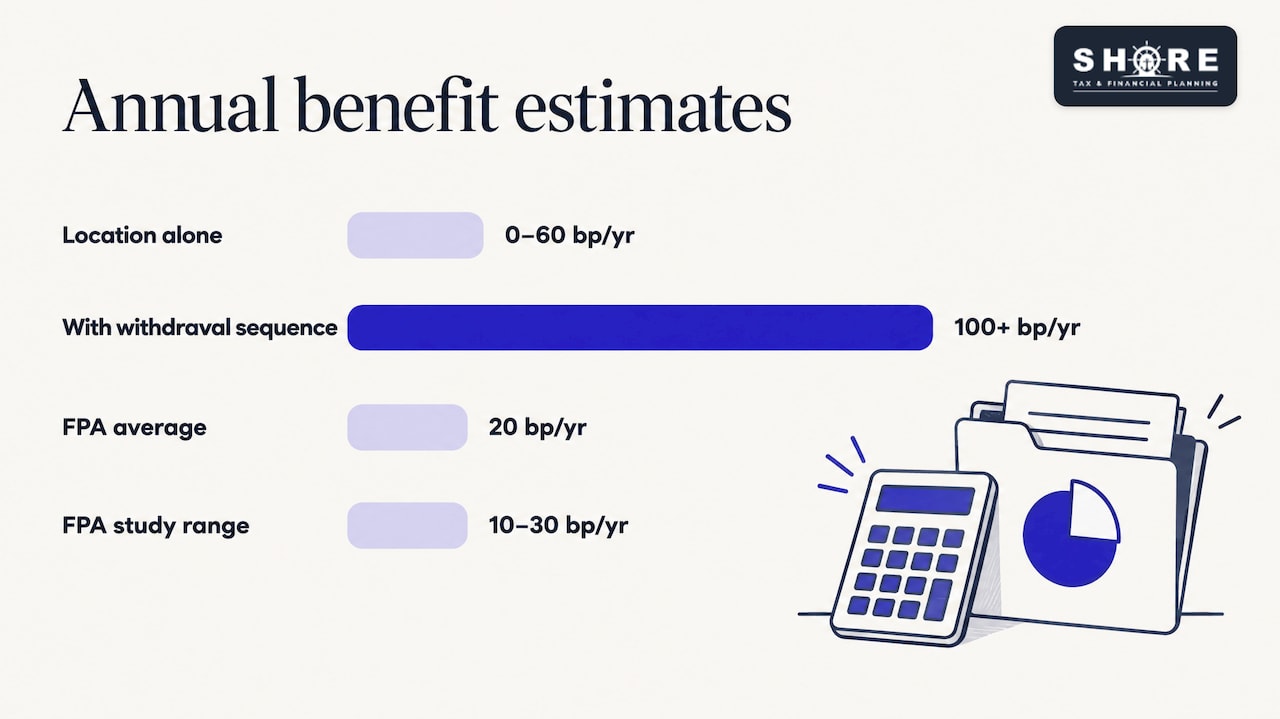
A simple ranking of tax efficiency does not always produce the best placement. The FPA authors argue that end wealth, not tax efficiency alone, should rank placement choices, because return, tax burden, time horizon and account size interact. Think through these before moving anything.
Account sizes. If your tax-deferred balance is smaller than your bond allocation, you cannot fit all the bonds there. Fill the tax-deferred account with bonds first, then place the remainder where it costs least.
Expected return. A high-return, tax-efficient asset can belong in a taxable account. A high-return, tax-inefficient one can belong in an IRA. Expected return comes first, tax drag second.
Time horizon and liquidity. Money you may need before 59½ should not be locked in retirement accounts. A taxable account holds your flexible dollars, so that is where the cash cushion and near-term goals live.
Selling to relocate. Moving holdings inside a taxable account can trigger capital gains. Inside IRAs and 401(k)s you can rebalance without tax. So the cleanest path is usually to redirect new contributions and use tax-sheltered accounts for the trades. Where you must sell in a taxable account, time it with realized losses and your bracket in mind. Our year-end stock portfolio tax strategies cover gain and loss timing in more detail.
Wash sales. If you harvest a loss in one account and buy the same security in another, including an IRA, you can trigger the wash-sale rule. Smartleaf notes that household-level coordination means avoiding wash sales and unnecessary turnover across accounts, not just within one.
Withdrawal order. In retirement, the sequence in which you draw from taxable, tax-deferred and Roth accounts interacts with location. Janus Henderson’s summary of the Vanguard research is why the combined gain can exceed the location gain alone.
Most investors treat their accounts as separate buckets and look at each statement alone. We look at the household. Your 401(k), your brokerage account, your Roth and, if you own a business, your company retirement plan are one balance sheet with three different tax rules.
As a fee-only firm, we do not earn commissions on products, so location decisions are made on after-tax outcomes and nothing else. We are both CPAs and CFPs, and the tax return is where location shows its results. Interest in the wrong account shows up as ordinary income on your 1040 year after year.
For business owners, the biggest lever is often upstream. The retirement plan you choose determines how much tax-deferred space you have to work with. A well-designed plan creates room for bonds and income-heavy holdings, which frees your taxable account for tax-efficient equity. That is why we coordinate investment placement with entity structure, retirement plan design and year-round tax planning, not as a separate exercise in January.
Our advice is to set your allocation first, fill your tax-deferred space deliberately, direct new money to where it is taxed least, and review once a year as your bracket and balances change.
Joseph
If you are a business owner, step 1 should include the plan you could add. Our overview of Solo 401(k) vs. SEP IRA shows how plan choice changes how much you can shelter, and our small business retirement plan services cover setup.
Asset location sits at the intersection of investing and tax, which is where we work. If you are a high-income W-2 professional, our year-round tax advisory and investment management puts location decisions into your overall tax reduction plan. If you own a profitable business, our year-round advisory and CFO services tie your retirement plan, entity structure and investments together.

As a fee-only firm, our advice is built around reducing your taxes, not selling products. To see how your accounts could be arranged, start with our tax reduction planning service.
No. Allocation is how much of your portfolio sits in stocks, bonds and other asset classes. Location is which account holds each of those holdings. You set allocation to match your risk tolerance, then use location to reduce the tax cost of that allocation.
Tax-efficient investments are the usual choice: broad stock index funds, ETFs with low turnover and, for some high-bracket investors, municipal bonds. Long-term gains are taxed at 0%, 15% or 20%, and you control when to realize them.
It matters less, because there is little bond interest to shelter. Benefits grow with the share of fixed income in your portfolio. Even so, deciding which equities go in your Roth versus your taxable account can still affect long-run results.
Usually not. Selling in a taxable account can create capital gains. Start by directing new contributions to the right accounts and rebalancing inside your IRA or 401(k), where trades are not taxed. Talk to a CPA or CFP before large taxable sales.
Once a year is a sound rhythm, or after a major change such as a new business plan, a large bonus, a move to a higher bracket or a Roth conversion. Reviewing before year-end gives you time to act on gains and losses.