

Section 174 amortization, the rule that forced you to spread domestic research costs over five years, no longer applies to domestic research in tax years beginning after December 31, 2024. Under the One Big Beautiful Bill Act (OBBBA), signed July 4, 2025, new Section 174A generally allows an immediate deduction for those costs. Foreign research is still amortized. And the years from 2022 through 2024 still leave balances on your books that you may be able to recover.
This guide explains what the old rule did, what replaced it, how to handle your unamortized balances, and where the traps are for business owners who build software, products or processes.
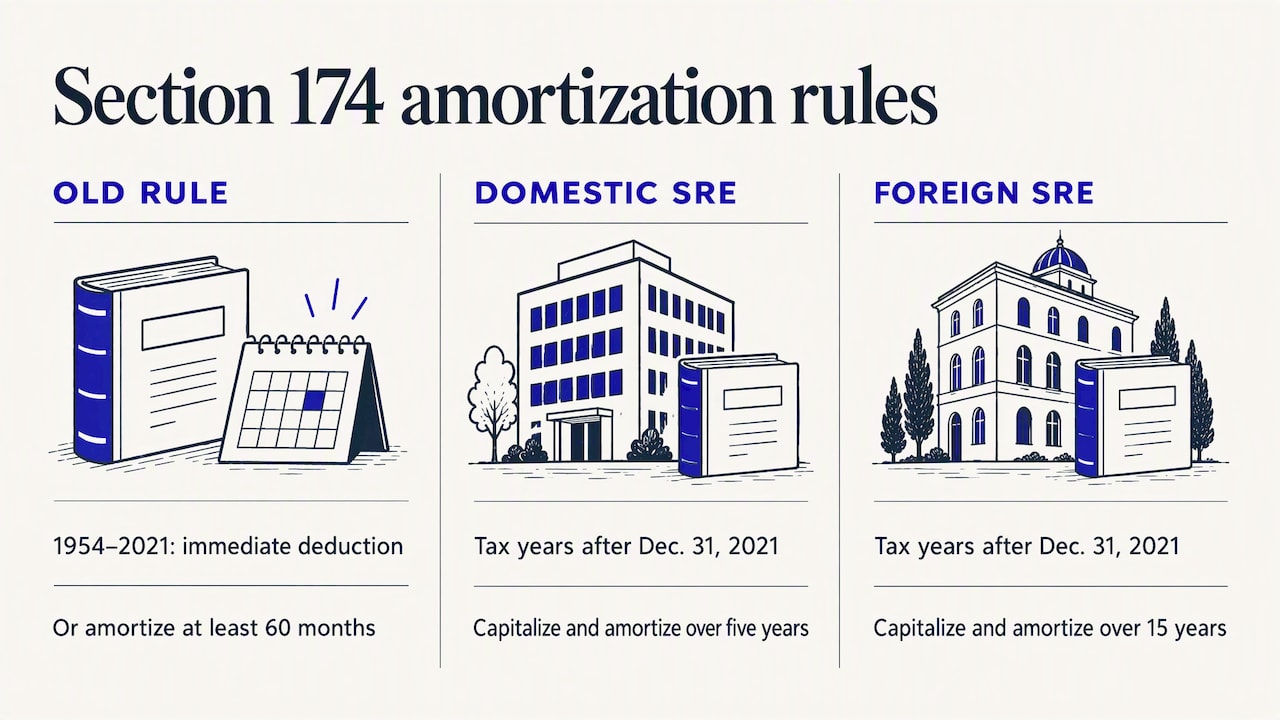
From 1954 through 2021, Section 174 let businesses deduct research and experimental expenditures immediately or amortize them over at least 60 months. Starting with tax years beginning after December 31, 2021, the Tax Cuts and Jobs Act (TCJA) took that choice away. Specified research or experimental (SRE) expenditures had to be capitalized and amortized: five years for domestic research, 15 years for foreign research.
The practical effect hit profitable companies hard. You could spend $500,000 on developer salaries in a year, yet deduct only a fraction of that amount in year one. Taxable income stayed high while cash was already out the door. A business with thin margins and heavy payroll could owe tax on profit it never really had.
The rule also reached further than most owners expected. It was not limited to laboratories. Software development costs were swept in, and the IRS issued guidance in 2023 and early 2024 on what counted. If your team built or improved a product, a process or an internal tool, you probably had Section 174 costs.
The costs that had to be capitalized generally included:
These are separate from the costs that qualify for the research credit, which generally include in-house wages, supplies, computer use and 65% of contract research. The two sets overlap but are not identical, and that difference matters when you reconcile your numbers.
The OBBBA reversed the policy for domestic work. The IRS summary of the law says domestic research or experimental expenditures paid or incurred in tax years beginning after December 31, 2024, are generally eligible for immediate deduction under Section 174A. The Congressional Research Service describes the earlier amortization regime as a deterrent to domestic investment, and frames the reversal as an effort to restore the incentives that existed before 2022.
Here is the practical map:
| Type of cost | Tax years beginning after 12/31/2024 | 2022 through 2024 |
|---|---|---|
| Domestic research and experimental | Generally deducted when incurred (Section 174A) | Capitalized and amortized over 5 years; transition options for remaining balances |
| Foreign research and experimental | Still capitalized and amortized over 15 years | Capitalized and amortized over 15 years |
If you are searching for the capitalization rules under Section 174, the short version is this: they still exist, but now mainly for research performed outside the United States. Domestic spending follows the new expensing default.
This is where most owners leave money on the table. Your 2022, 2023 and 2024 returns may show research costs that are still sitting on an amortization schedule. The OBBBA included transition rules, and the IRS published procedures for the elections in Internal Revenue Bulletin 2025-38, which covers the elections under section 70302(f) of the law.
At a high level, the path depends on who you are:
Read the revenue procedure’s election mechanics before you decide. Elections are made in specific ways, often with statements attached to timely filed returns, and a missed deadline can cost you the option. We treat this as a decision to model, not a box to tick.
Say your software company is a pass-through and, in 2023, it spent $400,000 on qualifying developer wages and related costs. Under the old rule you capitalized the full amount and deducted only part of it in 2023, with the rest scheduled over later years. By the start of 2025, a meaningful balance remains unamortized.
Under the transition rules, you may be able to take that remaining balance as a deduction in 2025, or split it between 2025 and 2026. That can sharply reduce taxable income in the year you take it. If your income is unusually high in one of those years, spreading the deduction can match it to the better rate. If the business is tiny and eligible for the retroactive route, amended returns may be the better move. Which one wins depends on rates, credits and state treatment, so we run the numbers both ways.

Immediate expensing does not automatically mean a lower tax bill. Tax professionals warn that restored basis adjustment rules can reduce the research expenses you deduct when you also claim the credit.
The mechanics, per the IRS instructions for Form 6765: you choose between the full research credit and a reduced credit under Section 280C. If you do not elect the reduced credit, you must reduce your Section 174A deductions or capitalized expenditures by the amount of the credit claimed. The election is made on your original, timely filed return and it is irrevocable for that year.
In plain terms:
The better path varies with your bracket, your state and whether you have other deductions competing for the same income. The election cannot be undone after you file, so decide before the return goes out, not after.
The Form 6765 instructions state that Section G, which collects business component information, is optional for tax years beginning before 2026 and, for most filers, becomes required after that. Even if you only deduct under Section 174A and never claim a credit, the direction is clear: the IRS wants to see which projects you worked on and what was spent on each.
Build the habit now:
Clean books are the foundation. We explain why in our piece on bookkeeping as your first line of defense in tax planning. If your research costs are mixed in with general payroll, you cannot defend the number. For a broader view of what draws scrutiny, see the IRS red flags that can trigger a small business audit.
Federal law is only half of the picture. State treatment remains inconsistent. According to the Tax Foundation, many states follow federal changes through rolling conformity, while others use fixed conformity dates or require add-backs. That can mean the immediate deduction is not fully recognized on your state return in places such as California, New York or Minnesota, according to a 2026 conformity roundup.
The Tax Foundation has also tracked individual states that chose to decouple, for example Delaware’s decision on full expensing.
What this means for you:
You should look closely if you are in one of these groups:
We see the same pattern with new clients. The owner knows that Section 174 “changed,” hears that the amortization is gone, and assumes the problem has solved itself. It has not, for three reasons.
First, the transition balance from 2022 through 2024 is real money and it has a clock on it. Choosing between a one-year recovery and a two-year split is a planning decision that depends on what else is happening in your income. That is exactly the kind of choice that gets made badly in March, when someone is rushing to file.
Second, the credit interaction is irrevocable once you file. A preparer who simply transfers numbers from your books will not ask you which election you want. Someone has to model both.
Third, the entity matters. If you run an LLC taxed as a sole proprietorship and your income has grown, a new deduction might push you toward a different structure. We often look at S-corp conversion alongside research expensing, because the two together change how much of your income is exposed to self-employment tax and how your deductions land.
We are a fee-only firm. We earn no commissions on products, so our advice rests on what saves you tax and holds up under review. Our lead advisor holds both CPA and CFP credentials and has run a business, which is why we ask about cash flow before we ask about deductions. A deduction that lowers your tax bill but starves your payroll account is not a win.
— Joseph
If you are a W-2 professional with an ownership stake in a company that does research, bring the schedule your company gives you. Your K-1 may carry the effect.
Research costs, credit elections and state add-backs are not a good fit for a once-a-year filing. Our tax reduction planning is built around year-round work: we review your books, model the elections, coordinate your entity structure and handle the return. If you want ongoing support from a CPA and CFP who can see your whole picture, start with our page for business owners or our page for high W-2 earners. We do not publish prices, so reach out through our main site to discuss your situation.
Not for domestic research in tax years beginning after December 31, 2024. Those costs are generally deductible when incurred under Section 174A. Costs capitalized in 2022 through 2024 may still be on a schedule unless you elect to recover them under the transition rules, and foreign research stays on a 15-year schedule.
Generally employee wages for the research work, supplies, and computer use, plus contract research. For the credit, only 65% of contract research counts, and stylistic, taste or cosmetic design costs do not qualify. Software development is the area where many owners are surprised by how much falls in.
Only if you make the reduced-credit election. Without it, you must reduce your deduction by the credit amount. The election is made on a timely filed original return and cannot be revoked for that year.
Not necessarily. Some states conform automatically, while others use fixed dates or require add-backs, so the state treatment varies. Check each state where you have nexus every year.