

Real estate professional status (REPS) is a federal tax classification that can turn rental losses from passive into nonpassive, so they may offset your other income. To qualify, you must perform more than 750 hours of services in real property trades or businesses in which you materially participate, and those hours must be more than half of all the personal services you perform in all your work during the year. Meeting those two tests is only the first step. You must also materially participate in the rentals themselves, and you must be able to prove all of it.
This guide walks through each test, what hours count, the mistake that trips up most high earners, and how to document your year so the position holds up.
The tax code treats rental real estate as passive by default. Passive losses generally can only offset passive income, so a rental that shows a paper loss (often because of depreciation) may not reduce the wages or business profit you earn elsewhere.
Per IRS Publication 925, a rental activity is generally passive, but if you qualify as a real estate professional and materially participate in the activity, it is not passive. That is the entire prize: losses that can be used against active income instead of being suspended and carried forward.
For a high-income W-2 earner or a profitable business owner, that difference can be large. It is also why the status draws attention, and why the rules are strict.
The IRS describes the requirements in Publication 527. You qualify for the tax year if you meet both of these:
Both are required, every year. Status is not permanent. You test yourself annually, and a year in which you take a demanding job or step back from your properties can end it.
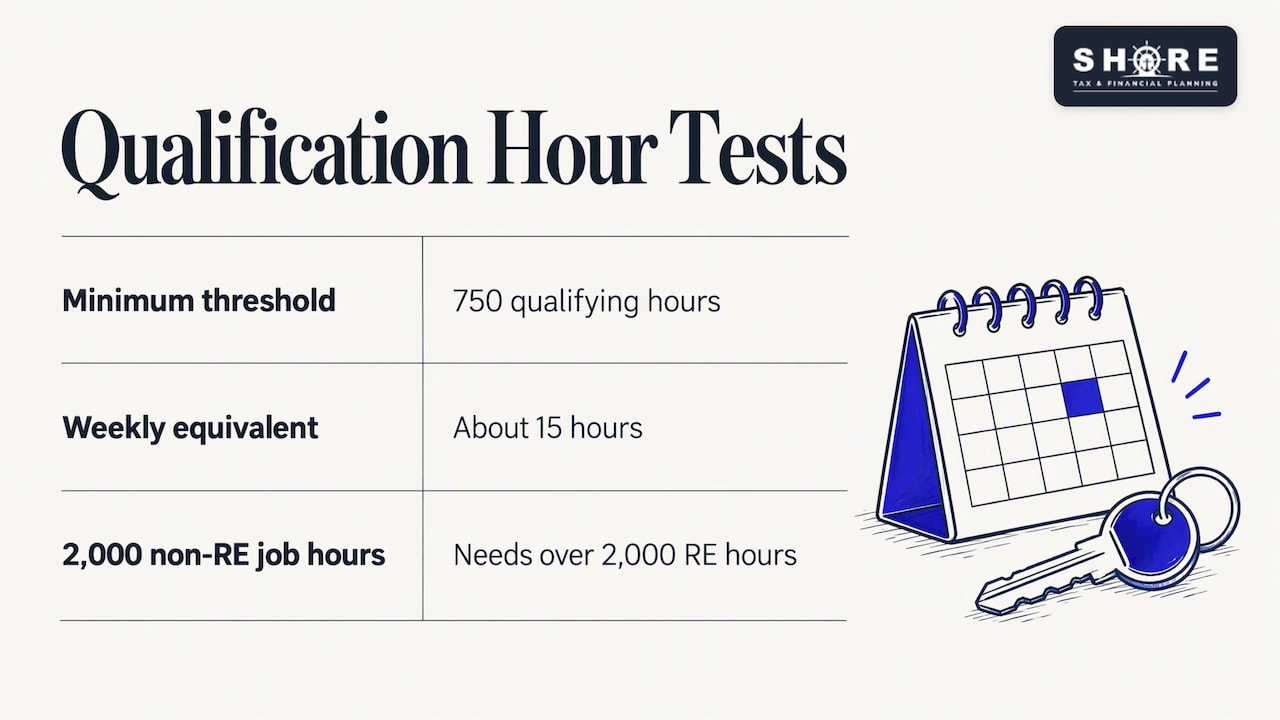
The 750 hours is roughly 15 hours a week. That is achievable for a full-time investor. The more-than-half test is where people with demanding careers fail. If you work 2,000 hours a year at a job that is not real estate, you would need more than 2,000 hours of qualifying real estate work on top of it. Realistically, someone working a full-time W-2 job in a non-real-estate field cannot pass.
This is why the status tends to fit people whose main occupation is real estate, such as investors who manage their own portfolio full time, developers, and brokers or agents who also hold rentals. It rarely fits a surgeon, an attorney or an executive with a long work week who owns a few rentals on the side.
A real property trade or business, according to Publication 925, covers development, redevelopment, construction, reconstruction, acquisition, conversion, rental, operation, management, leasing and brokerage. Work in any of those can count, provided you materially participate in the business.
Some practical examples of work that tends to qualify:
And some things that do not help, or need care:
Spouses cannot pool hours to reach the thresholds. When you file jointly, one spouse must separately meet both the 750-hour and the more-than-half tests without counting the other spouse’s services, per Publication 925. A common planning structure is for one spouse to be the full-time real estate operator while the other earns the W-2 income. That arrangement has to reflect how the work is actually divided.
Here is where many taxpayers go wrong. Passing the 750-hour and more-than-half tests removes the automatic passive label from rentals. It does not by itself make your losses nonpassive.
The instructions for Form 8582 make this clear: you must also prove that you materially participate in each rental activity, or elect to aggregate your rental activities into one. Each interest in rental real estate is treated as a separate activity unless you make that election, per Publication 527.
That matters because if you own six properties and have not elected to aggregate, you may have to show material participation in each one individually. Spreading 800 hours across six properties could leave you short on every single one.
Material participation can be met in several ways. As The Tax Adviser summarizes, you can participate more than 500 hours during the year, or satisfy other tests, such as being responsible for substantially all of the participation in the activity.
The election to treat all rental real estate interests as a single activity lets you add up your hours across properties when testing material participation. It is made with a statement on your return, and it generally binds you in future years. Because it has consequences down the road, make the decision with your CPA before you file, not after an IRS letter arrives.
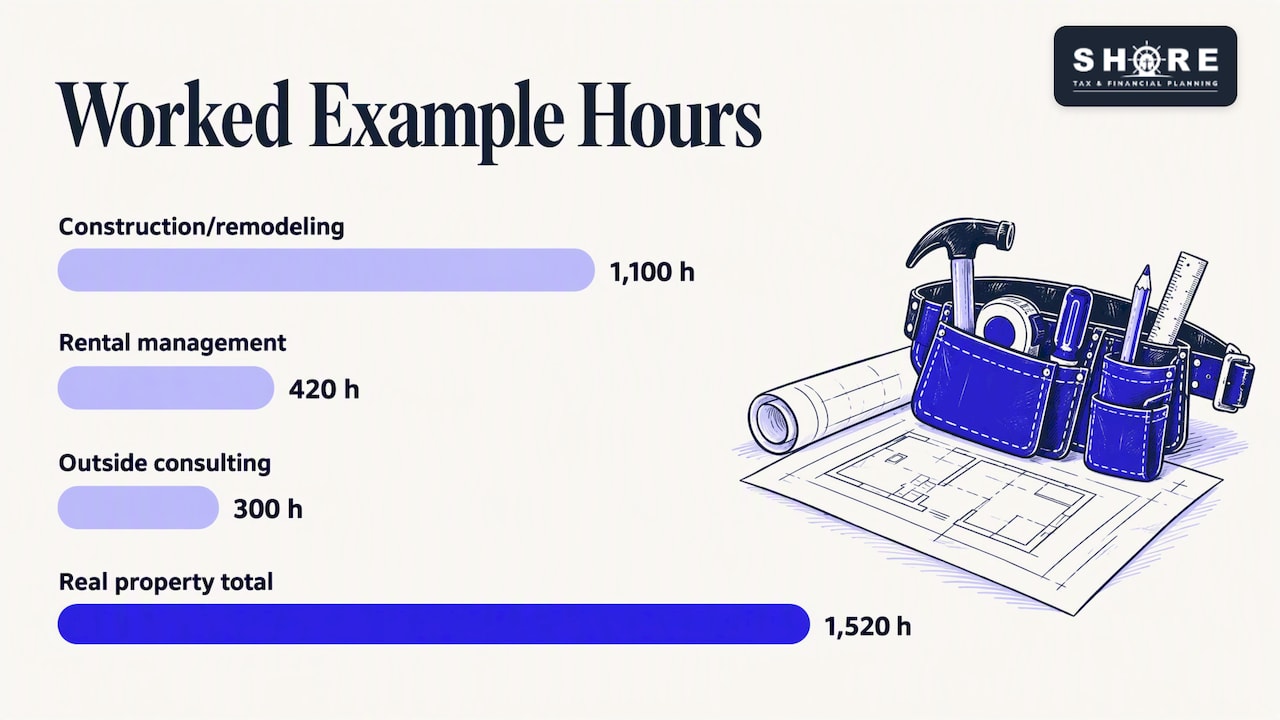
Imagine a contractor who owns an S corporation (more than 5%) that builds and remodels homes, and who also owns four rental houses. Over the year:
| Activity | Hours |
|---|---|
| Construction and remodeling work in his own company | 1,100 |
| Managing and maintaining the four rentals | 420 |
| Total real property work | 1,520 |
| Work outside real estate (a seasonal consulting role) | 300 |
His real property hours are 1,520 of 1,820 total, well over half, and above 750. He passes both threshold tests. For the rentals, he must still show material participation. If he elected to aggregate the four houses, his 420 hours of rental work would be tested as one activity and fall short of 500 on the simple hours test, so he would need another test, such as being the one doing substantially all the work. If he did not elect, each house has fewer hours still. The outcome depends on facts and elections, not only on the headline numbers.
This is an illustration, not a prediction for your return. The point is that three separate questions get answered: the threshold tests, material participation, and the aggregation election.
Real estate professional status is one of the most examined areas in rental taxation, and the disputes usually turn on records. The IRS expects you to keep records that support both your income and your expenses, as it says in its rental real estate recordkeeping guidance.
Courts are blunt about reconstructed time. The Tax Court is not required to accept a “ballpark guesstimate” or unverified testimony, according to the Journal of Accountancy. The same article recommends a contemporaneous log of hours and the services performed.
A log that holds up usually has these features:
If you own property out of state, documentation matters even more. Panitz and Lubin note that travel records and contractor invoices are essential to overcoming the IRS’s built-in skepticism of remote landlords.
For more on organizing records so they are ready before anyone asks, see our guide to financial documentation strategies.
The professional literature points to the same trouble spots again and again. The Tax Adviser lists audit risks that include weak or inconsistent logs, out-of-state properties, the use of management companies, and counting on-call hours as work.
Translate those into habits to avoid:
The IRS also uses risk-based analysis during an examination, including decision points partway through the audit to decide how far to go, as described in IRM 4.10.3. A well-kept file can shorten that process. For a broader look at what draws attention to a return, read our article on IRS red flags that can trigger an audit.
It depends on three things: whether your honest hours can pass both tests, whether you have meaningful rental losses to unlock, and whether you have income to offset.
It tends to be worth a serious look when:
It tends to be a poor fit when you work a demanding non-real-estate job and would have to stretch the facts to pass. In that case there are often other ways to reduce your tax bill, and your CPA can map them for you. Our article on real estate investment tax strategies for service business owners covers some of them.
The two are unrelated, and the overlap in wording causes confusion.
A licensed agent who is a Realtor is not automatically a real estate professional for tax purposes. Their hours still have to meet the tests, and so does the material participation requirement for any rentals they own. Likewise, an unlicensed investor who manages a portfolio full time can qualify.
Most of the REPS questions we get come from people who heard the term at a dinner party and want to know if they can “just claim it.” Our answer is that it is a position you earn through your calendar, not one you elect on a form.
What we do instead is look at the whole picture before the year ends. We ask how many hours you truly work in real estate, whether your spouse’s role changes the math, and whether aggregation helps or hurts. If you do not qualify, we look at other levers, such as cost segregation, S-corp planning, retirement plan contributions and entity structure, that can lower your tax without asking you to stretch the facts.
We are a fee-only firm. We earn no commissions on products, so the only thing we have to gain is a position that is accurate and defensible. Our lead advisor is both a CPA and a CFP® and has run a business, which shapes how we think about documentation. We keep the file clean from day one, because the best time to build proof is while the work is happening.
Joseph
If you own rentals and wonder whether this status is realistic for you, the answer comes from running the numbers on your actual hours, your properties and your income, ideally before the year closes. Our tax reduction planning is built around year-round work with business owners and high earners, so the review happens while you can still act on it.

If your properties are large enough to benefit from accelerated depreciation, our cost segregation service can quantify the deductions. We can then test whether your hours support using the losses. You can also reach our team through shorefp.com to start a conversation.
You must perform more than 750 hours of services during the year in real property trades or businesses in which you materially participate. Those hours must also be more than half of all personal services you perform in all your work. Both tests apply every year, per Publication 527.
Keep a contemporaneous log showing the date, property, task and time for each entry, and back it with emails, invoices, calendar items and travel records. Reconstructed estimates are weak evidence, and courts need not accept them, according to the Journal of Accountancy. Your CPA can set up a simple system at the start of the year.
No. On a joint return, one spouse must meet both the 750-hour and the more-than-half tests on their own hours, as Publication 925 explains. The other spouse’s work does not count toward those thresholds.
No. You must also materially participate in each rental activity, or elect to group your rentals into one activity, according to the Form 8582 instructions. Qualifying only removes the automatic passive treatment.