

A cost segregation study usually costs a few thousand dollars for a smaller property and more for large or complex ones. The fee depends on the property’s size, type and documentation, and on how detailed the study needs to be. The better question is what the study returns. If the first-year deductions are many times the fee, it is worth doing. If they are not, it isn’t. This guide shows you how to price a study, how to test the return on your own numbers, and what to look for in a proposal.
When you buy or build a property, the tax code normally has you depreciate the whole building over 27.5 years (residential rental) or 39 years (nonresidential). A cost segregation study breaks that single number apart. According to the IRS cost segregation audit techniques guide, a study allocates or reallocates lump-sum property costs to individual assets or asset groups with different recovery periods for federal income tax depreciation.
In practice, the study separates real property from tangible personal property such as certain flooring, specialty electrical, cabinetry, and equipment, and from land improvements such as paving, landscaping and site lighting. Those components depreciate over five, seven or fifteen years instead of 27.5 or 39. The same IRS guide frames the split as § 1250 real property versus shorter-lived § 1245 personal property.
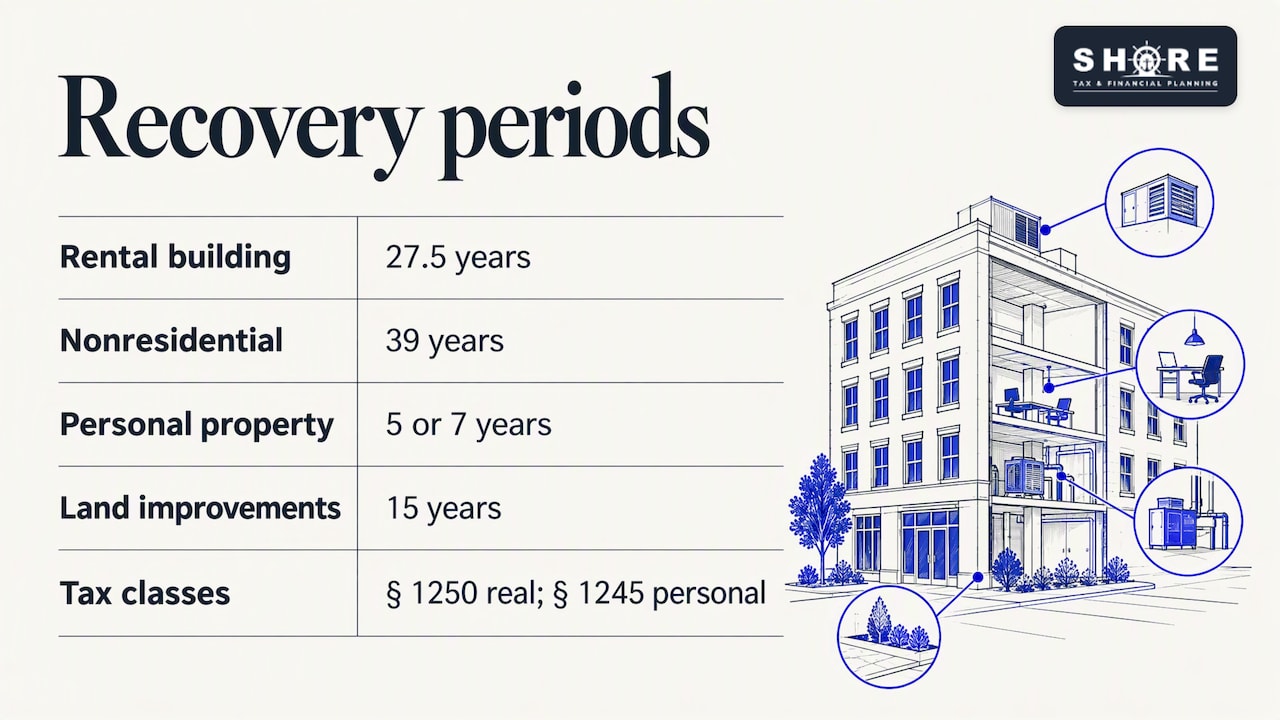
The total depreciation over the life of the asset does not change. What changes is timing: more deduction early, less later. That timing is what you are paying for.
There is no single posted price, and anyone quoting you one before seeing the property is guessing. Here is how the market generally works.
These are general ranges, not quotes. Public pricing varies by provider and region, and some firms price as a flat fee while others price as a percentage of the purchase price or of the expected tax benefit. Treat any number you read online, including ours, as a reason to ask better questions, not as a budget.
We do not publish a fixed price for cost segregation. Scope varies too much from property to property, so we quote after reviewing your purchase documents and goals.
Four things move the price more than anything else.
Two smaller factors also matter: how many assets or buildings are in the property, and whether you need a study on a property you already own for several years. A look-back study can still capture missed depreciation, but it requires additional filing work, which your CPA should price separately.
The fee only makes sense next to the benefit. Run this quick test before you request proposals.
Suppose you buy a commercial property for $1,000,000, and $200,000 of that is land, which is never depreciated. Your depreciable building basis is $800,000.
If the study cost $5,000 in this case, the first-year deferral is about ten times the fee. If the same property produced only a 5% reclassification, the deferral would be about a quarter of that, and the math would be closer. This is why we run the numbers before anyone orders a study.
This is an illustration, not a prediction. It assumes you can use the deductions, which depends on the rules below.
Shorter recovery periods are valuable, but bonus depreciation is what turns them into a first-year deduction. The IRS audit guide notes that bonus depreciation under § 168(k) allows immediate expensing of certain assets, and that changes in federal depreciation rules can change the value of a study. You need to know which rate applies to the year the property was placed in service.
For property acquired after January 19, 2025, legislation passed in 2025 restored 100% bonus depreciation, which materially improves the first-year benefit of a study on recent purchases. Property acquired earlier may fall under a reduced phase-down percentage. Confirm the rate for your specific placed-in-service date with your CPA before you rely on any projection, because this is where studies are most often mis-sold.
A study is a deferral strategy. When you sell, the IRS guide explains that §§ 1245 and 1250 can convert what would have been capital gain into ordinary income, to the extent your basis was reduced by accelerated depreciation. In plain terms: you took a large deduction early, and part of it can come back as taxable income at sale.
That does not make a study a bad idea. Deferral has real value, and a planned exit can soften the result, whether through holding long term, a like-kind exchange, or a partial disposition election when you replace a building component. Our article on partial asset dispositions explains how that works. The point is to model recapture next to the savings so that the net benefit is real.
Two proposals for the same property can differ by thousands of dollars and by what you actually receive. Compare these items line by line.
| What to check | Why it matters |
|---|---|
| Study method | Engineering-based with a site visit, or desktop estimate? The method affects defensibility and the reclassification percentage. |
| Who prepares it | Qualified engineers and tax professionals working together, with clear credentials. |
| Fee structure | Flat fee, percentage of basis, or percentage of savings. A fee tied to savings can create pressure to inflate the result. |
| Deliverables | Full written report, asset schedule with recovery periods, photographs, and the methodology narrative. |
| Tax filing support | Whether the proposal includes Form 3115 for look-back studies and the depreciation schedules your CPA needs. |
| Audit support | Whether the preparer will help respond if the IRS asks about the report, and at what cost. |
| Timeline | Turnaround from receiving documents to delivery, so you can use the results on the right return. |
| Assumptions | What reclassification percentage the estimate assumes, and what it is based on. |
A free estimate is fine as a first screen. Be cautious when a provider promises a specific percentage of reclassification before seeing the property. The IRS guide stresses that a study is a technical analysis based on the actual property, so a number promised in advance is not one.
Also ask whether the person selling the study is independent of your tax return. A study works best when your CPA sees the output and builds it into your overall plan, including estimated payments, the passive loss rules and any other deductions you are using that year.
Not every property justifies one. A study is usually worth a close look when:
It is often not worth it when the basis is small, when losses would be suspended for years, or when you plan to sell within a short period without a plan for recapture. In those cases, a conversation with your CPA may show that a different strategy, such as a retirement plan or an S-corp election, saves more for less.
Most cost segregation conversations start with the fee, and we think that is backward. We start with your return. Before a study is ordered, we look at your income, your entity structure, whether the losses can be used, what bonus depreciation rate applies, and when you expect to sell. Only then does the fee have something to be compared to.
We are fee-only, and we do not earn commissions on products. That matters here, because a study is a place where an advisor could benefit from recommending one whether or not it helps you. Our job is to tell you when the numbers do not justify it, and to say so plainly.
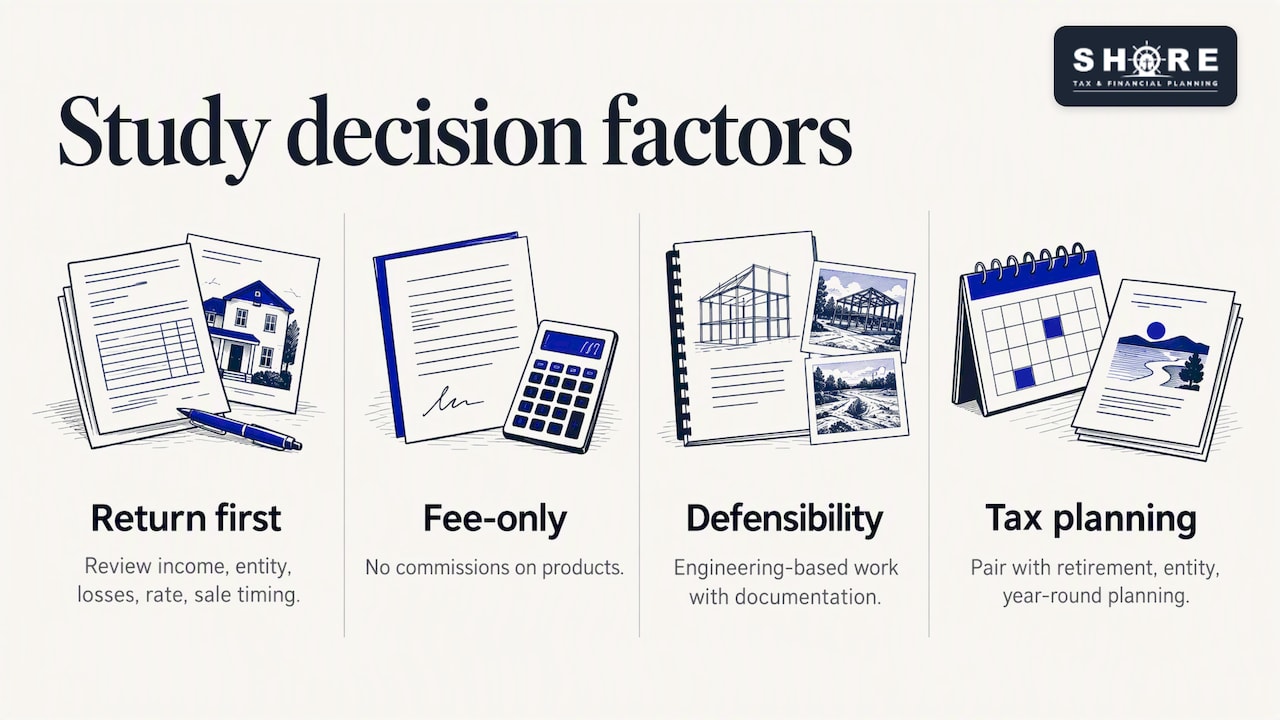
We also treat defensibility as part of the price. A study that saves money this year and invites questions later is not a bargain. We favor engineering-based work with documentation, because the goal is a deduction you can keep.
Finally, we see cost segregation as one lever, not a plan. For high-income professionals and business owners, it often works best alongside retirement plan design, entity structure and year-round tax planning, so the deduction lands in the year you need it.
— Joseph
If you own or are buying investment or business property, we can review your purchase documents, estimate whether a study makes sense, and coordinate it with your tax return and long-term plan. You can see how we approach it on our cost segregation service page, or read our longer guide to cost segregation studies and real estate tax savings.
If you want it tied into the rest of your tax strategy, our tax reduction planning work covers it alongside entity, retirement and year-end planning.
For a smaller property, expect a few thousand dollars. Larger, more complex properties cost more, and some are quoted case by case. The fee depends on size, property type, study method and the records you can provide. Ask for a written scope before comparing prices.
It often is when you have a large depreciable basis, taxable income to offset, and a reasonable holding period. Compare the expected first-year tax deferral to the fee, then subtract the effect of recapture at sale. If the savings are only a small multiple of the fee, or the losses would be suspended, it may not be worth doing.
The IRS treats a study as a technical analysis that should follow accepted methodology and be supported by documentation. A do-it-yourself estimate rarely holds up if questioned. Most owners use qualified engineers and tax professionals, and review the results with their CPA.
No. It speeds up depreciation you would claim anyway, so total depreciation over the life of the property stays the same. The benefit is timing, which is why recapture and holding period belong in the analysis.