

You do not have to dissolve your LLC or form a new company to convert it to an S corp. You keep the LLC and file IRS Form 2553 to have it taxed as an S corporation. Once the IRS accepts it, you pay yourself a reasonable salary through payroll, and the rest of the profit can come out as distributions that are not subject to self-employment tax. The election pays off when profit is high enough to cover the extra payroll and compliance work, and it only works if the details below are handled correctly.
An LLC is a state-law entity. An S corporation is a federal tax classification. Those are two different things, which is why the word “convert” confuses so many owners.
In most cases, nothing changes at the state level. Your LLC stays an LLC, keeps its name, its bank accounts and usually its EIN. What changes is how the IRS taxes it. Under the IRS’s own guidance, filing Form 2553 means an LLC is deemed to have elected corporate classification in addition to S status. The Form 2553 instructions add that an eligible entity that timely files and meets the other requirements is treated as a corporation as of the election’s effective date and does not need to file Form 8832.
Some owners do form a new corporation or file state conversion paperwork for other reasons, such as investor expectations or state-specific requirements. For the tax outcome, the election is what matters.
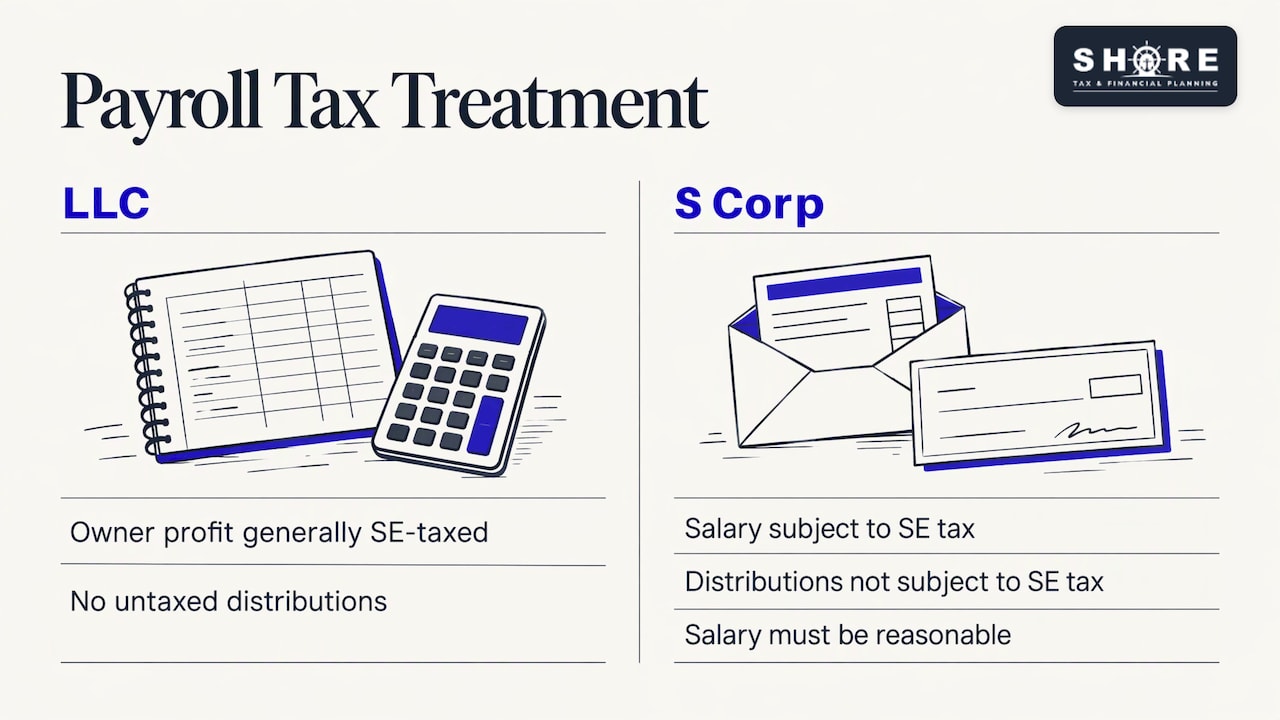
The reason is payroll tax. A standard LLC owner’s profit is generally all subject to self-employment tax. In an S corporation, distributions to shareholder-employees are not subject to self-employment tax, while the salary you pay yourself is. That gap is where the savings come from.
The gap only exists if your salary is reasonable. A shareholder’s salary must not be unreasonably low, and payroll taxes apply to that salary rather than to the entire amount of business income. A salary set too low to capture more savings is the most common way this strategy turns into an audit problem.
For a deeper walkthrough of how those savings work, see our guide to cutting self-employment taxes legally with an S corp. If you are a contractor, our article on why New Jersey contractors are switching from LLCs to S corps shows the same logic in a specific trade.
There is no single profit number that works for everyone. Think in terms of what the election adds and what it costs.
What it adds: payroll processing, a separate corporate return (Form 1120-S), and a salary that is taxed for payroll purposes even in a slow month.
What it saves: payroll tax on the portion of profit that moves from salary to distributions.
Here is an illustration, not a client result. Say your LLC nets $200,000 and a defensible salary for your role is well below that figure. Without the election, self-employment tax applies to the full profit. With it, payroll taxes apply to the salary, and the remainder is distributed. The larger the gap between profit and a reasonable salary, the larger the potential savings, and the more the added costs are worth carrying.
The election tends to make sense when:
It tends to be a poor fit when profit is thin or irregular, when you want to allocate profits unevenly among owners, or when you plan to bring in outside investors. Professional commentary notes that S corporation rules, including the one-class-of-stock limit, can restrict flexible profit allocations and make attracting new investment harder. Those are structural points to plan around, and a good plan addresses them before you file.
The IRS sets the rules. To qualify, a corporation must be domestic, have no more than 100 shareholders, and have only one class of stock. Shareholders may be individuals, certain trusts or estates. They may not be partnerships, corporations or nonresident aliens.
The same IRS page notes that certain banks and thrift institutions, insurance companies and domestic international sales corporations are ineligible.
For a typical multi-member LLC, the practical checks are:
On that second point, an operating agreement can contain provisions that invalidate an S election if they are not revised beforehand. Have it reviewed by your attorney and your tax advisor together before you sign Form 2553.
Run the numbers on your actual profit, a defensible salary, payroll costs, the extra return and any state-level entity fees. Do this before you commit, not after.
Make sure it supports one class of stock and that every member is eligible. Amend it if needed.
Most owners choose January 1, so that the S corporation covers a full calendar year. A mid-year start is possible for a new election, but it splits your year into two tax treatments and adds complexity.
The form asks for entity information, the effective date and tax year, and shareholder information including names, addresses, ownership and consent. It must be signed by an authorized officer, and every shareholder must consent. You can mail or fax it to the IRS center listed in the instructions. Keep proof of delivery.
The rule: Form 2553 must be filed no more than 2 months and 15 days after the beginning of the tax year the election takes effect, or at any time during the preceding tax year. For a calendar-year LLC that wants S status for the whole year, that means March 15 of that year at the latest, and any time in the prior year works too.
Missing it does not always end the plan. The IRS has provisions for late-election relief, and the Form 2553 instructions cover how to request it. Act quickly and talk to a CPA, because relief generally depends on your having filed returns consistently with S status.
Federal S status does not always carry over automatically. Some states treat it differently:
If you are in New Jersey or any other state, confirm its election and entity-level filing rules with your CPA before the federal deadline passes.
This is the step owners skip, and it is the one that makes the election work. You need a payroll system, a documented salary, and monthly books that separate wages, distributions and business expenses.
Once you pay yourself wages, you are an employer. Employers generally file Form 941 quarterly and Form 940 annually, give employees Forms W-2, and deposit employment taxes on the required schedule.
Your S corporation files Form 1120-S. According to the IRS tax calendars, it is due by the 15th day of the 3rd month after the end of the tax year, which is March 15 for calendar-year filers. Profit passes through to your personal return on a Schedule K-1.
Salary is subject to withholding, but the distributions are not. Your share of pass-through profit still creates income tax you owe, so quarterly estimates still matter. Individual estimated tax payments are due on the 15th day of the 4th, 6th and 9th months of the tax year and the 15th day of the 1st month after it ends. Many owners raise their own salary withholding or make estimates from the business’s actual results, so ask your CPA to build a simple quarterly projection and avoid surprises.
Owner health insurance and retirement contributions are handled differently in an S corporation. Our article on S corp health insurance explains how to report it correctly. You can also pair the election with a small business retirement plan so that salary decisions and plan contributions work together.
There is no official percentage you can safely use. The test is what a business would pay someone to do the work you do. Document it:
Keep that file with your tax records. If the IRS ever asks, a written, market-based rationale is your strongest defense. That is also the reason a strategy that is built carefully holds up. Our firm reports a 0.01% audit rate on the strategies we implement, and we treat documentation as a core part of every conversion.
We approach an S corp election as a planning decision, not a form to file. The paperwork takes an hour. The decisions around it, such as the effective date, the salary, the payroll setup, the retirement plan and the operating agreement, determine whether the election saves you money for years or creates a problem.
We are fee-only. We earn no commissions and sell no products, so the only question we answer is whether the election lowers your tax bill in a way that holds up. Sometimes the answer is yes and the savings are substantial. Sometimes the right move is to wait until profit grows, and we will say so.
Our lead advisor holds both CPA and CFP credentials and has run a business, so the advice comes from both the tax code and the practical side of payroll, cash flow and growth. We also stay with clients all year. The election is the start. Quarterly check-ins on salary, estimates and deductions are where the savings are kept.
Joseph
We help profitable business owners and high earners decide whether the S corp election fits, then carry it through: the numbers, the Form 2553 filing, salary documentation, payroll setup and ongoing bookkeeping and tax returns. Our S corp conversion services cover each step, and our tax reduction planning keeps the strategy working after the election.

If you want to see whether your profit supports the switch, start on our S corp page or learn more about year-round advisory for business owners. Our broader piece on year-round tax planning explains why timing matters so much.
No. In most cases the LLC continues to exist under state law, and you file Form 2553 to change its federal tax treatment. An eligible LLC that timely files Form 2553 is treated as a corporation as of the effective date and does not need Form 8832. Check your state for any extra election or fee.
File Form 2553 no more than 2 months and 15 days after the start of the tax year you want the election to take effect, or at any time during the preceding tax year. For a calendar-year business, that is March 15. If you have missed it, ask a CPA whether late-election relief applies to you.
Yes, if the owner is an eligible shareholder such as a U.S. individual and the entity meets the other S corporation requirements. The same Form 2553 applies. The election does not change the fact that the LLC has one owner, but it does bring payroll and a separate corporate return.
Your salary has payroll tax withheld, but distributions and pass-through profit still create income tax you owe. You generally pay individual estimates in April, June, September and January. Your CPA can set a quarterly projection based on actual results.
Often not yet. Payroll, a corporate return and state fees add real cost, and the savings depend on the gap between profit and a reasonable salary. Run the numbers with your CPA on your actual profit before you file.